
Are you an Expert or an Imposter? In Blackboard Fridays Episode 31, Jacob talks about Learning and Development. Need this implemented into your business? Talk to the international business advisor who can do exactly that – Contact Jacob, Learn More, or Subscribe for Updates.
‘The Peter Principle’ is a theory of management that says people in large corporations eventually get promoted beyond their skill set. Do your job well enough, and you’ll keep being promoted until you go one step too far and start struggling.
‘The Dilbert Principle’ is a theory that only the incompetent are promoted, intentionally removing them from important work by making them managers.
Either way, the risk to your fragile ego is clear: have you climbed the ladder to success based on your expertise, or are you faking it … without getting any closer to making it?
Through the power of the internet, I’m able to reach through and assess your situation in detail….
Here’s the good news – you got this. It’s obvious to me even from here that you know what you’re doing.
But if you ever want an objective tool to help you assess expertise – in yourself, or in your team – then blow up a balloon and enjoy this week’s #BlackboardFridays episode here.
Who is Jacob Aldridge, Business Coach?
“The smart and quirky advisor who gets sh!t done in business.”
Since April 2006, I’ve been an international business advisor providing bespoke solutions for privately-owned businesses with 12-96 employees.
At this stage you have proven your business model, but you’re struggling to turn aspirations into day-to-day reality. You are still responsible for all 28 areas of your business, but you don’t have the time or budget to hire 28 different experts.
You need 1 person you can trust who can show you how everything in your business is connected, and which areas to prioritise first.
That’s me.
Learn more here. Or Let’s chat.
Transcript
This week, we’re asking a question a lot of people go through as their career progresses: “Am I an Expert or am I an Impostor? Am I in this position because everyone else thinks I’m something … that deep down I know I’m not?”
Business Owners can certainly feel this themselves, though I would encourage you to remember the confidence (however naive) you had to found this business in the first place.
The greater relevance for business owners often comes when you’re recruiting or promoting employees. If you ever hired someone who said they were an expert at something and then later discovered they didn’t actually have the capability that you needed? Or you’ve probably got somebody in your team right now that downplayed their skills, that thinks that they’re far behind the curve when in fact they’re one of the best that you’ve got?
This is one of the challenges with measuring skills across a business: the people who know the least often feel that they know the most, and the people who know the most are always aware of the fact that there’s more that they can learn and so they downplay their expertise.
Measuring Expertise: Evidence Overcomes Doubt
The tool that I use when I’m talking about skills with individuals, particularly those facing the imposter syndrome, or with management teams / leadership teams / entire business training programs, is to objectively define and measure some of the different levels of learning that an individual goes through.
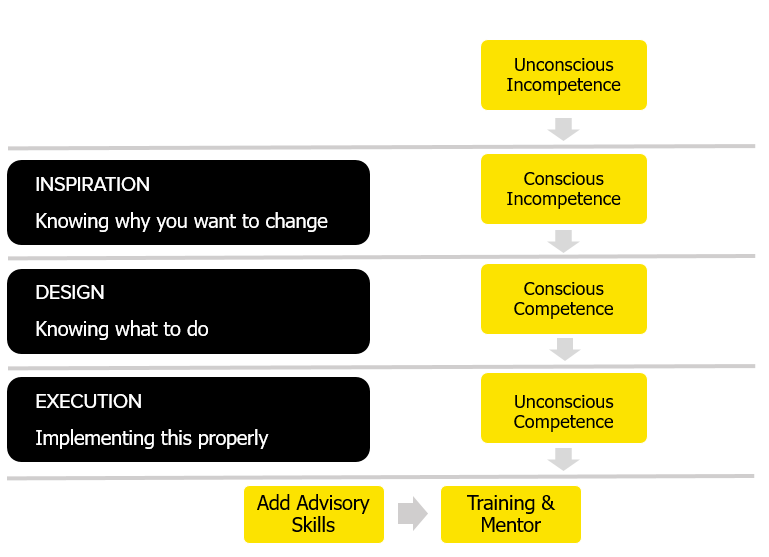
Can You Drive a Car?
Let’s explain these Layers of Learning using an example most of us can relate to: Driving a Car.
At a starting point, at the top of this framework, we are Unconsciously Incompetent. If you think about a four-year-old, even a 14-year-old, and the skill of driving a car, they don’t know what they don’t know. They’re completely useless at that skill, AND they’re not actually aware of just how useless they are. They don’t have the capability to understand it! And that’s how many people with a whole lot of skills in business.
Twenty years ago none of us had any idea how social media worked – but that didn’t bother us, we weren’t staying awake at night wondering about how we ranked on Facebook or how many Instagram followers we added this week. We were Unconsciously Incompetent (and ignorance, sometimes, is bliss!).
Inspiration
At some point in our education journey, we get a flash of Inspiration. We suddenly have a reason WHY we want to understand a certain skill. For driving, that might be freedom, it might be flexibility, it might be the ability to go and pick up your girlfriend or boyfriend.
That inspiration to learn the skill shifts us from Unconsciously Incompetent to Consciously Incompetent. We’re still useless … but now we know that we’re useless. That’s a challenging space for many people to find themselves -again, ignorance can be bliss.
Design
What we need to do in this situation is go into a Design and Education process on that skill. We need to shift ourselves from Consciously Incompetent to Consciously Competent, where we now have that skill, that expertise.
This can take the form of things like driving lessons, practice a hundred hours in your logbook with your parents, to take that desire to learn a skill and understand WHAT is involved in doing that skill for yourself.
Once you have that skill, then you can move down into execution.
Execution
You can implement a skill – driving out there on your own, racking up the hours behind the wheel – until you eventually reach the point where you’re Unconsciously Competent.
You now have that skill embedded at such a level that you don’t need to think about it. You get to the office car park in the morning, and you haven’t even thought about whether you stopped at any red lights, checked for pedestrians, or breezed through that annoying pedestrian crossing. You’re not even thinking about it now because you’ve got the skill level embedded to the point where you can focus on other things while you’re executing that.
Business Skills: Inspiration, Design, Execution
Now as a skill set within businesses, and we’re going to talk about this in specific detail next week, you can take any skill and ask yourself or ask the individual involved
- Are you clear about WHY this skill exists?
- Do you know WHAT is involved? Can you actually write down and design the elements that are required to implement that skill?
- Lastly, are you actually executing it? Because the act of executing, just as the act of writing it down, just as the act of being inspired, helps take us further down the level of expertise.
Overcoming Imposter Syndrome
What I find doing this exercise is that having those objective definitions helps some of those people away from the Dunning-Kruger effect. They start to realise, ‘Ahh, there’s actually more I don’t know’, ‘I haven’t implemented that so maybe there’s more I can learn’, and some of those people who have been doing it for years, who are Unconsciously Competent and haven’t even realized the level of their expertise, can start to tick off where they’ve managed to achieve skills deeper than they realised.
Deeper Layers of Learning
Now there are other Layers of Learning.
Beyond Execution, you could TEACH somebody to drive (and for the sake of humanity I will never, ever teach somebody to drive because deep down I haven’t even mastered Execution. I’m still conscious, I’m not 100% competent, behind the wheel of a car.)
And this is an important lesson when testing people’s skills – it’s not necessary for every person in your team to have all of the skills all of the way down.
At the end of the day when it comes to the skills that you and your team need in your business, having them doing it to the best of their ability with an idea of how they can enhance their ability over time, means that they’re all focused on achieving what needs to be achieved, instead of running around thinking they’re an expert when they’re not and getting in the way, or worse still actually having skills that they can contribute and feeling that they’re not worthy.
Next Steps
Want to learn more about how this can apply to your business? It costs nothing to chat:
- Email me jacob@jacobaldridge.com (I read them all)
- Call, Text, or WhatsApp me +61 427 151 181
- Or just Subscribe https://jacobaldridge.com/about/subscribe-to-jacob-aldridge-com/ to stay in touch