
Welcome back, to the first episode in the 2026 Season of Don’t Waste a Good Recession. For those unaware, I spent many years 2008-13 travelling the world delivering presentations on responding to the Global Financial Crisis and Great Recession, and then also helped businesses through the Coronavirus Recession with this key message: You can Thrive, not just Survive.
Here we go again…
Action Items from this video
- Make sure you are subscribed to my business emails by clicking here – receive business tips and strategies, as well as timely economic news
- Sharing is Caring – post this link on your socials, stick it in the work Slack group, or embed the video in your next company newsletter
- Curious for more? Join my Don’t Waste A Good Recession Facebook group, find me on your favourite Podcast platform, or subscribe and comment on the YouTube channel
- Need to go deeper? Talk to me about keynote speaking and tailored workshops – I visit 6-10 countries per year, so these can be arranged in person or virtual worldwide.
Notes
Economic Cycle and Market Conditions
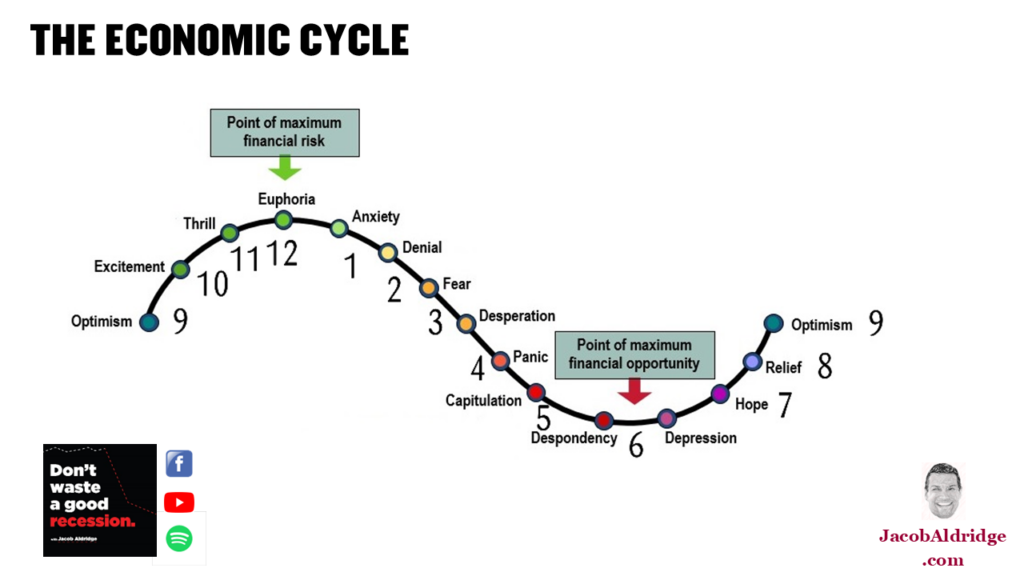
- The global economy is entering a downturn phase, shifting from euphoria to anxiety. This creates critical risks for small and medium businesses – and more importantly, moves us all closer to the Point of Maximum Financial Opportunity.
- Early stages of economic downturn confirmed with market anxiety rising
- Asset prices in stocks, property, bonds, and commodities depend on future buyer expectations.
- Overconfidence at the cycle peak, especially in AI stocks, signals unsustainable valuations.
- Unpredictable crash triggers could include AI stock corrections, geopolitical tensions, or commodity shocks.
- Businesses must prepare for an inevitable downturn despite uncertainty about timing or cause.
- Shift from maximum financial risk to maximum opportunity as markets cool
- More opportunities are created in an economic downturn than at any other point in the market cycle
- Customers and suppliers become open to change during recessions, enabling strategic moves.
- Historical recession patterns show businesses can capitalize if you position well ahead.
Business Responses to Economic Downturn
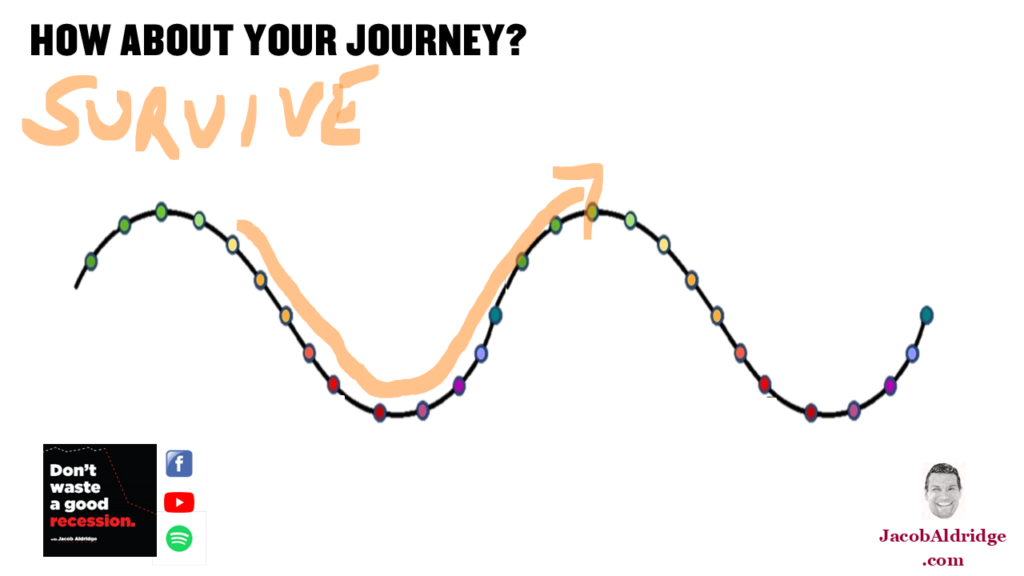
- Businesses respond to a Recession in one of three ways: they Dive, Survive, or Thrive. The difference is their emotional and investment management.
- Three distinct business reactions to recession conditions defined
- Dive businesses are already struggling and cut back sharply, risking failure.
- Survive businesses follow market trends passively, recovering only when conditions improve.
- Thrive businesses actively seek growth and transformation despite downturn pressures.
- Recognising your business category is critical to choosing the path forward.
- Emotional management is key to business resilience and growth
- Dive businesses ignore or suppress emotions, leading to inaction and failure.
- Survive businesses react impulsively to feelings, leading to inconsistent decisions.
- Thrive businesses acknowledge emotions without being controlled, enabling strategic choices.
- Ongoing, deliberate investment decisions differentiate thriving businesses from others.

Investment and Leadership Strategy During Recession
- Active, emotionally-aware leadership, and continued strategic investment underpin business success in downturns.
- Strategic investment must continue despite uncertainty
- Waiting for perfect conditions delays action and causes missed opportunities.
- Leaders must balance emotional awareness with disciplined decision-making.
- Business lifecycle stage and growth phase influence investment choices.
- Consistent active choices set thriving businesses apart in volatile markets.
- Leadership emotional intelligence drives business outcomes
- Leaders ignoring anxiety or fear risk business collapse.
- Embracing emotional realities helps maintain focus and resilience.
- Hope alone is not a business strategy.
- Emotional insight supports better investment timing and resource allocation.
Recession Outlook and Government Response
- This recession is expected to differ from the coronavirus downturn, with less government stimulus and more market-driven adjustments.
- Limited government stimulus anticipated in this recession
- Unlike previous recessions, large-scale government spending is unlikely.
- Businesses must rely more on internal strategies than external bailouts.
- Understanding recession patterns helps prepare businesses for different recovery scenarios – and you can see more from the last series of Don’t Waste a Good Recession on my YouTube channel.
- Additional resources offered for business leaders seeking deeper insights
- Subscribe to my newsletter for additional content
- Follow on your Podcast or YouTube platform
- Reach out to discuss my keynote speaking and business workshops focused on leveraging recession opportunities.
Speaker Profile and Availability
- Jacob Aldridge leverages extensive recession experience to guide businesses through downturns with tailored presentations and workshops.
- Proven track record as a recession keynote speaker and thought leader
- Recognised as a Virtual Speaker Hall of Fame nominee for pandemic recession work.
- Offers global virtual presentations and in-person sessions.
- Focuses on practical strategies for small and medium businesses to thrive in recessions.
- Invites organisations to engage for customised workshops on maximising downturn opportunities.
FULL VIDEO TRANSCRIPT
Welcome to Don’t Waste A Good Recession Season 2026, Episode 1, “The Point of Maximum Opportunity”. Transcription by Fireflies.
I’m your host, Jacob Aldridge. This is not my first rodeo.
So what is happening in terms of the global economy, the local economy, and what does that mean for small and medium sized businesses between 2 and 500 employees? That’s the focus of the Don’t Waste a Good Recession podcast and YouTube channel. Well, we are now in the early stages of an economic downturn. There can be no doubt. There have been conversations. I put out some material in the Don’t Waste a Good Recession Facebook group over the last 12 months about all the various things that are happening. This is inevitable. Economies, markets go through this economic cycle. It’s human nature.
It’s an important thing to understand that the price of assets and in particular things like stocks, property and even bonds, commodities are all based on what buyers need today. Yes, in some cases, but mostly what they believe things are going to be worth in the future. If you are confident that shares are going to be a lot cheaper in the future, you’re not going to buy them today. And similarly, if you’re confident they’re going to go up, up, then you want to get in today. Maybe you borrow a heap of money to be able to do that. This leads to two key points on the economic cycle.
The one that we’ve probably been experiencing bit lately, the point of maximum financial risk at the top 12 o’, clock, top of the clock, top of the economic cycle euphoria where there is some unjustified overconfidence in the future value of assets. And importantly, there’s a lot of talk about AI stocks over the last 18 months, two years and what that might mean for being a bubble. The economy is like a race car. If you speed a race car down the motorway, if you keep accelerating and accelerating, a crash is inevitable. What you can’t predict is exactly when you’re going to crash or what the specific cause might be. Maybe you take your eye off the road, maybe you make a mistake driving, maybe a wheel blows, maybe a goose flies into your windscreen. There will be a crash.
We just don’t know the exact cause. And it’s exactly the same with the global economy right now. Whether it’s going to be AI stocks being overpriced, whether it’s going to be tariffs, whether it’s going to be the war in Iran or oil shock. There is going to be a downturn and the feeling right now is certainly shifting from that euphoria into 1 o’, clock, 2 o’. Clock. We’ve got a lot of anxiety going on. And if you watch the Prime Minister of Australia’s national address this week, an awful lot of denial. We need to do things, we’re doing a lot of things. But actually, don’t worry, nothing needs to change. Well, I disagree, particularly when it comes to your small business, your livelihood.
But you see the other point in this chart, the point of maximum opportunity, and that’s where I want you to be focusing as this series evolves. Because more opportunities, more market share is created in an economic downturn than at any point in the economic cycle. When things are going really well, your customers, your suppliers, you are quite content to be fat and happy. Nothing needs to change. But when the markets change, when that fear, despair really kicks in, that’s when change occurs. And if you are well placed in advance, then you can seize that opportunity when the transformations occur. And we’re gonna talk a lot more, or you can go back and have a look through the historic videos, podcasts that are all still available from the last recession, where we talked about a lot of these concepts. Importantly, history rhymes.
Every recession follows a pattern and is unique. It runs in its own small way. So when recessions occur, when economic downturns occur, businesses respond in one of three ways. What I like to say is quote Mike Tyson, everyone has a plan until they get punched in the face. Back in January, whether you wrote it down, whether you had a strategy day, whether it was just a gut feel or a word you had for 2026, you had a plan. And if you’re trying to fill up the tank with gasoline or diesel right now, maybe you’re already feeling that punch to the face. Maybe you’re just responding to the news, to what people are saying to staff who are requesting to work from home a little bit more because of the increased gas prices, the oil shock, whatever it might specifically be for you’re observing it.
You’re experiencing that punch has either come or you fear it may be coming soon. Businesses respond in one of three ways. The first is the ones that dive, they take that hit. And they were usually the ones who were already struggling, who were already on edge. The they weren’t experiencing the euphoria, or if they were spending the money long before it really even hit the bank account. They take that punch, they dive, they will not make it through this recession. The second category, the majority of businesses, are the ones who survive when the economy, the market, their local market or their sector goes down, they go down with it. And it will only be when that wider market moves back up that they will move back up.
They will follow the slings and arrows of outrageous fortune, feeling at effect of the wider economy instead of being at cause and empowered, which is what the third category of small business is really excited to be doing right now. And I’m amongst them, the ones who want to thrive, who want to make the most of this opportunity, who can see the point of maximum opportunity and are rubbing our hands together thinking what can we do with this economic downturn to make the most of it for the long term success of our business, to grow our business. How do you know which of those you are in and how do you choose to be the thriving business as opposed to one who just survives or dives?
Well, it comes down fundamentally, and we’ll talk a lot more about these over the coming weeks and months, to how you manage your emotions as a leader and how you manage your investments. A business owner. The businesses that dive, the businesses that will not make it through another tough economic winter, are the ones who ignore their feelings. Whether it’s anxiety, denial, fear, despair, however strong it might be, they’re the individuals who try and block it out, leave the emotions at the door. Emotions have no place in business. They do. You’re a human and if you ignore it, they’re not going to go away. If you’re not dealing with them, you’re not going to be able to use that to your advantage.
And when it comes to investing, when it comes to spending money on new initiatives, change staff, the dive businesses are the ones who stop. They just say, I’ve taken that punch to the face, this is all too hard, I’m just going to stop and see what happens. Bury their head in the sand, hope for the best. And as we know, in good times or in bad, hope is not a strategy. The ones who survive, well, they are more conscious of their feelings, their emotions, but they react to them. It’s a key saying that I’ve been applying in my life for a long time. Between action and reaction, you have choice from Viktor Frankl. When you feel your feelings, all feelings are valid. Not all behaviour is supportive and positive for you.
When you react to your emotions, when you have a bad day, a bad news, bad energy bill, a bad diesel bill, filling up the tanks, looking at the fuel cards, if you react to that without controlling your emotions, then again you are just at effect of external circumstances and that’s that. Survive at effect a good day, you’re happy a bad day, you’re bad. You’re sad, you’re mad. Your team don’t want to talk to you. Your customers think maybe we should find somebody else right now. And when it comes to investment, again, you’re reacting to what’s going on. So I call that down low too slow. You’re going to stop investing now while it’s uncertain, while you’re not sure what to do. And you’re going to wait until not the slightest little green shoots, not the lead indicators.
You’re going to wait until everything’s going well again before you jump back in. And that means you’re going to miss that point of maximum opportunity. If you want to be a business that thrives, you’ve got to acknowledge your emotions. You are a human. Feelings are a huge particularly in small and medium sized businesses. You got to acknowledge the feelings that you’re having. Not be controlled by them, not own them. You’ve got to be willing to let them go without denying that they exist. And when it comes to investing today and into the future, it’s being strategic, it’s being ongoing, it’s making sure that you continue to make the right decisions.
And some of them may be difficult depending on exactly your business and where you’re at in the business life cycle, the phases of business growth, all of these other factors that are going to come into play. But you keep making active choices and that is what is going to differentiate the businesses that thrive from the ones who merely survive or who dive out completely. And in a broader economic sense, the businesses that dive is not a bad thing. Unlike the coronavirus recession, I am not expecting governments to come flooding in with a lot of stimulus to buy their way out of this downturn. And we’ll talk more about why that might be in future episodes. What’s this recession going to look like? What’s the downturn going to look like? Well, time will tell.
Subscribers at JacobAldridge.com have got an extra video this week looking at the three different shapes of recessions to help look ahead. And and that’s another topic that we will talk about. So make sure you head over. Subscribe jacobaldridge.com you can join the Facebook group. Don’t waste a good recession. Follow us, your favourite podcasting platform or your YouTube channel. If you need something more dramatic, if you’re more than curious, you are really wanting to make that challenge. You want to talk some more, reach out to me. Jacobacobaldridge.com I I’m a keynote speaker in particular on the topic of how to leverage a recession for the point of maximum opportunity.
This year I’m primarily going to be in Australia, Singapore, London and Paris, and so we can find dates there if those are suitable to you or I’m available anywhere in the world except the United States of America. As a person of colour, I am not safe going to the United States of America at this point, but I am also a Virtual speaker hall of Fame nominee from the work that I did during the last recession and the many virtual online presentations I gave around the world on the topic of don’t waste a good recession during the Coronavirus pandemic. So wherever you are in the world, whether you want a speaker for your business, for your organisation, or a tailored workshop for the group that you are looking after, feel free to reach out and to have the conversation.
I will see you in the next video.