

The source of More Client Conversion. In Blackboard Fridays Episode 17, Jacob talks about Sales, Marketing, and Customer Journey. Need this implemented into your business? Talk to the international business advisor who can do exactly that – Contact Jacob, Learn More, or Subscribe for Updates.
Let me tell you the story of Dan. Dan, and his wife Anne*, ran a building services company generating about $3 million in revenue each year. It wasn’t more customers they were chasing – they just wanted a holiday.
But both they, and their sales team, were at capacity – it was next to impossible for them to step out of the business for anything more than a lunch break. So I worked with them on a project to source better clients.
In this week’s #BlackboardFridays video, learn about the 3 ways we examined their client base to understand which source of new customers was most efficient, and how we changed their budget just a little to create the same amount of revenue in less time each week.
I’ll also share where Dan and Anne went on their holiday.
*Names changed so I can share their actual financial data
Who is Jacob Aldridge, Business Coach?
“The smart and quirky advisor who gets sh!t done in business.”
Since April 2006, I’ve been an international business advisor providing bespoke solutions for privately-owned businesses with 12-96 employees.
At this stage you have proven your business model, but you’re struggling to turn aspirations into day-to-day reality. You are still responsible for all 28 areas of your business, but you don’t have the time or budget to hire 28 different experts.
You need 1 person you can trust who can show you how everything in your business is connected, and which areas to prioritise first.
That’s me.
Learn more here. Or Let’s chat.
Transcript
Bigger is not always Better
The most common questions I receive are about how to source more revenue, more sales, more clients? This week, though, I want to talk you through an analysis project I did with Dan and his business – where “more clients” was the last thing he wanted.
Dan is a building contractor, a tradie, doing about $3 million a year in revenue.
His issue wasn’t getting more clients necessarily – it was finding more time. He needed better quality clients, so that he and his team didn’t have to work quite so hard.
In fact, Dan’s #1 brief to me as his business coach was, ‘Help me have a holiday. My wife and I haven’t had a holiday in almost ten years and if you can help me do that, without impacting the three-million-dollar revenue that we’re doing or our profit margins, then you’ve done your job.’
So, this is the analysis we did.
Source: Where Do Your Clients Come From
The first step was, thankfully, straightforward. Dan and his team had been tracking the source of all their clients over the years – whenever the phone rang or an email enquiry came through, they would ask (and record) how that client had found them. If you are not already doing this, start immediately!
So we were able to break down where the existing clients were coming from. This was an exercise they had done at a ‘gut feel’ level a few times, so it was pretty quick to add some data. We broke their lead generation sources into five categories
- Repeat clients
- Referral clients
- Clients that came from their website
- Clients became direct to their showroom, and
- Clients that came from advertising.
Now being a building manufacturer, they didn’t get a lot of repeat clients – the products last eight to ten years. They knew they needed a steady supply of incoming clients, which is why they invested so much in marketing. Here was the results of that analysis.

They were a little bit surprised that advertising was bringing in half of all their business, but they weren’t completely shocked at that. They knew that that’s where they were investing their money and that was showing.
Leads for Show, Convert for Dough
The next analysis I did with them, however, revealed some issues with their strategy: We had a look at Conversion Rate by Lead Source. “If you had ten clients coming from each of those sources, how many of those would convert and become your customers?”
This was not an exercise they had ever done before, and they had limited intuition about the results. What we found was this—a very different looking graph.

(Note that unlike the Lead Source, this doesn’t have to add up to 100%. It’s the independent conversion rates for each category.)
Repeat clients converted at about 40%. No surprise there—they’d used the business before, they knew Dan and his team, they trusted him.
Referral clients converted at about 20%. Again, they came with a strong recommendation, and they were happy to convert.
Those figures dropped across Web, Showroom, and Advertising – which I found was converting at just 10%. If they had 10 enquiries, this drop off was a difference between four clients buying the product and one client buying the product.
Click Here to Read the Blackboard Fridays Sales Series.
Converting just 10% is really low. Some of these ‘opportunities’ were discarded from the Sales Hourglass immediately, but most of them took just as much Sales Team time (or even more) as those Repeat and Referral clients. So we could immediately see that to get them more clients, better clients to free up some capacity in their sales team and for Dan, we needed to find a way to convert more efficiently.
AI’s Biggest Flaw as a Strategist
Was Sales Training the answer? This was pre-ChatGPT (I’ve been coaching since Tony Blair and George W Bush were running the world) but it’s a great example of where business owner intuition and GenerativeAI likeability create real problems.
Sales Training is the obvious answer for low conversion rates. And if you ask ChattyG etc for help … it has learned that you want an agreeable and supportive assistant, not someone disagreeable. You’ll get some sales tips – but AI (Actual Intelligence, or should I say “Aldridge Intelligence“) knew that sales training was not the answer.
Dan was at capacity. His personal vision was to take more holidays with Anne. Winning More Clients is a terrible idea – but chatbot coaches don’t have that context, and they rarely ask for it.
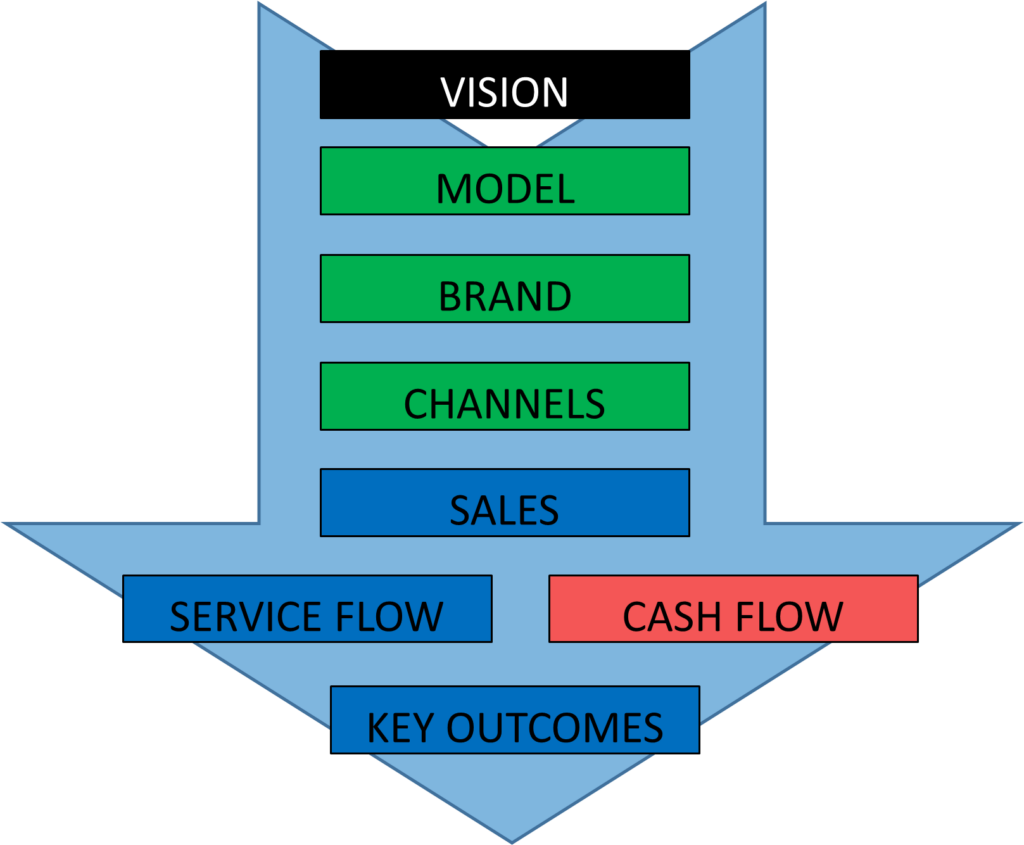
No, for Dan and Anne the solution lay in applying the Revenue Flow framework, not delivering Sales Training.
Channels Not Sales
Throughout this whole exercise, I’ve been focused on their Channels to Market, not the Sales Team. Channels are the step before Sales in the Revenue Flow diagram – and as we often find, a problem in one of these steps can be better solved by going one step beforehand. What did I say about Aldridge Intelligence – though of course all my clients get these frameworks to use forever.
So the third question I asked was, ‘Where’s your budget? Where are you spending the money?’ Not surprisingly, because of where most of their clients were coming from, the giant chunks of their budget were spent on advertising.

None of that budget was spent on repeat or referral clients. They have no loyalty programs in place, they didn’t put any time into follow-up calls, checking in with existing clients to see if they were happy with the product, who else they knew they might be looking to buy?
The low conversions rates for the Advertising channel had led to the intuitive – but detrimental – solution that more money needed to be spent in that space. And because most of the leads came from that Advertising, it felt to Dan like his strategy was working.
Instead, his strategy made him so busy he hadn’t taken a holiday in 10 years. With all 3 sets of data, we could now see the solution.
We don’t need more clients, we need better clients – leads that are more likely to convert (and, which is related, be happy paying a higher price). Sales training was the red herring: How could we take some of that $5,000/month advertising budget, that was converting at just 10%, and put it into activities that were going to bring more prospects through the door that were converting at 20%, 30%, 40% or more?
And yes, we would eventually move down the Revenue Flow and work to improve those sales conversions. (I even got to do some Field Days with their sales team which converted at 100%, which made me look much smarter than I truly am). We also worked on Service Flow with their manufacturing team, and Cash Flow with their office team, and found similar improvements there.
But the biggest shift was redeploying their budget to refocus exactly where their clients were coming from. Reducing ad spend to implement a Referral Program was not only fast, it didn’t cost them any more money.
Now this balance meant they had the same number clients, but they had better clients, more profitable clients, and clients that they converted much more easily.
Six months later, Dan and his wife spent a month with some friends on a sailboat around Thailand. That’s a pretty good outcome.

Next Steps
Want to learn more about how this can apply to your business? It costs nothing to chat:
- Email me jacob@jacobaldridge.com (I read them all)
- Call, Text, or WhatsApp me +61 427 151 181
- Or just Subscribe https://jacobaldridge.com/about/subscribe-to-jacob-aldridge-com/ to stay in touch



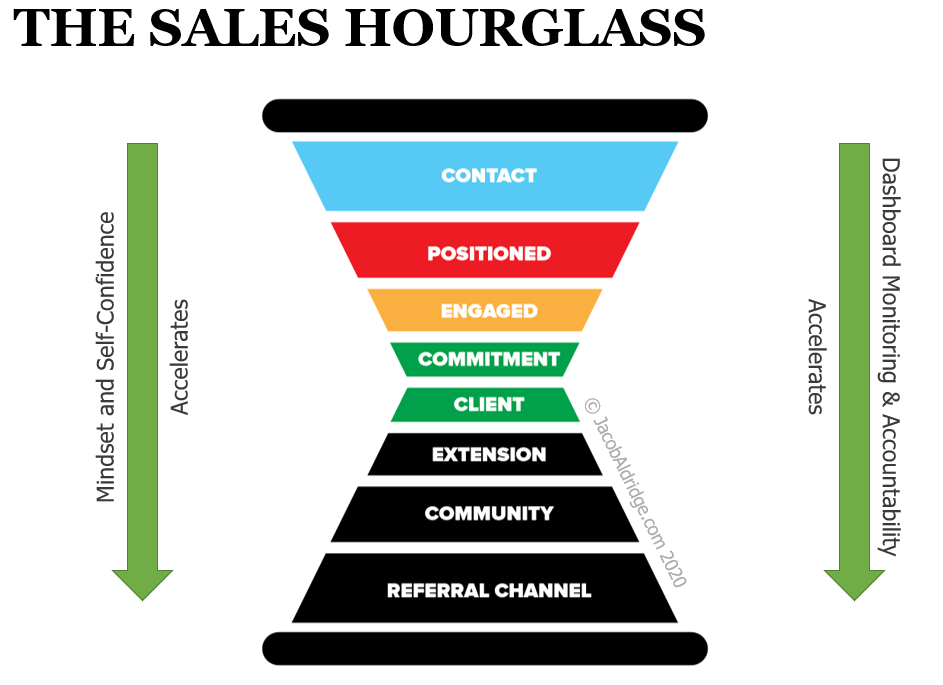
[…] you back to episode 12 where we talked about the five attractants for your sales hourglass and also episode 17 where we did a case study as to which lead generation sources converted at the highest percentage. […]