

How to Run More Efficient Meetings. In Blackboard Fridays Episode 28, Jacob talks about Productivity. Need this implemented into your business? Talk to the international business advisor who can do exactly that – Contact Jacob, Learn More, or Subscribe for Updates.
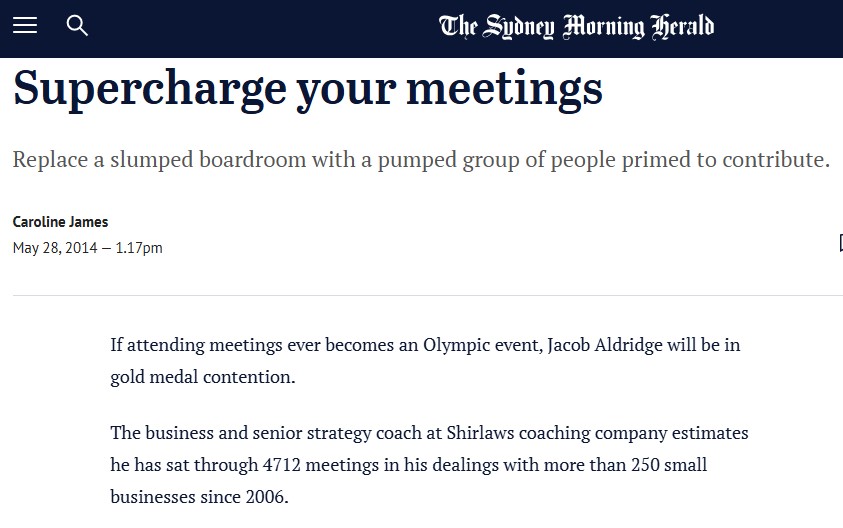
Did you know that the Sydney Morning Herald once declared me a “gold medal contender” should meetings ever become an Olympic event?! Check out my terrible tie as well here.
And it’s true – I’ve attended thousands of meetings. I know why some people view all meetings as a complete waste of time … and how you can be the exception.
This week’s video is designed for anybody who has ever sat through an awful, boring, and unproductive meeting. We call it the Momentum Meeting Model – and I guarantee that if you use this approach then the value of your meetings will increase enormously.
Or double-the-cost of your free Jacob Aldridge subscription will be returned.
Think about the next team meeting you need to run. Would you rather have a gold medalist helping? Let’s chat…
Who is Jacob Aldridge, Business Coach?
“The smart and quirky advisor who gets sh!t done in business.”
Since April 2006, I’ve been an international business advisor providing bespoke solutions for privately-owned businesses with 12-96 employees.
At this stage you have proven your business model, but you’re struggling to turn aspirations into day-to-day reality. You are still responsible for all 28 areas of your business, but you don’t have the time or budget to hire 28 different experts.
You need 1 person you can trust who can show you how everything in your business is connected, and which areas to prioritise first.
That’s me.
Learn more here. Or Let’s chat.
Transcript
Here’s a fun story. The Sydney Morning Herald newspaper in Australia once referred to me as an Olympic gold medallist for meetings. We calculated that I had attended more than four and a half thousand meetings in my time as a business coach … and that article was in 2014!
What that means is I have a good idea of how to make good meetings great, and why so many meetings completely fall apart and then become an enormous pain.
A lot of businesses blame meetings for the problems that come out of them. To me, blaming meetings for bad operations is a bit like blaming a spoon for the reason you keep eating all that ice cream.
When you have the right approach for running your meetings, then they will run with momentum, bring energy to your team, and they will serve their purpose which is bringing people together to communicate and decide before disseminating you back out into the business to execute.
The purpose of meetings is to bringing people together to (1) communicate and (2) decide before (3) disseminating you back out into the business to execute.
As always, it would be remiss of me not to acknowledge that the other global Gold Medal contender is the impeccable Dr Carrie Goucher. I am but a humble practitioner, an abecedarian, while Carrie has a freaking PhD in leveraging meetings to create greater commercial and cultural outcomes.
The Momentum Meeting Model
Here’s a quick overview of the simple approach to running better meetings.
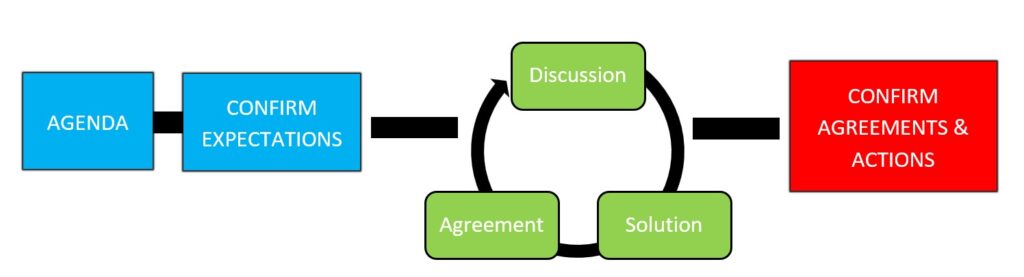
Step 1: You Need to Have an Agenda
Your agenda might be set in advance; it might be something that you do live in the room at the start of the meeting – giving each individual an opportunity to contribute and then agree on that agenda.
Whichever you choose, you need to agree the whole agenda before you can start discussing the specific items that are on it.
This is one of the most common ways in which meetings go bad. Whoever is ‘chairing’ the meeting (usually informally) grabs the very first agenda item that comes up, all of the attendees dive in and try to resolve that specific topic, and ultimately you run out of time without getting through the rest of the items.
Step 2: Triage
Once you have all those Agenda items agreed, you need to triage. You need to set the right expectations with the attendees – how much time have we got? Is there anybody in the room who maybe needs to take a phone call? Is there a fire drill scheduled for half way through the allotted time?
One thing that I say is always very helpful is having one person who’s responsible for taking notes. They will be documenting at the very least everything that is agreed and every action that is agreed. And in 2026, this no longer needs to be one “person” – I personally use Fireflies as my AI meeting recorder of choice, and I know other companies have their preferences too – if you’re recording the meeting via handwriting, video, or AI, se that expectation now as well.
Step 2 is where you triage that agenda – and it’s entirely possible that you won’t be able to cover everything that is on it.
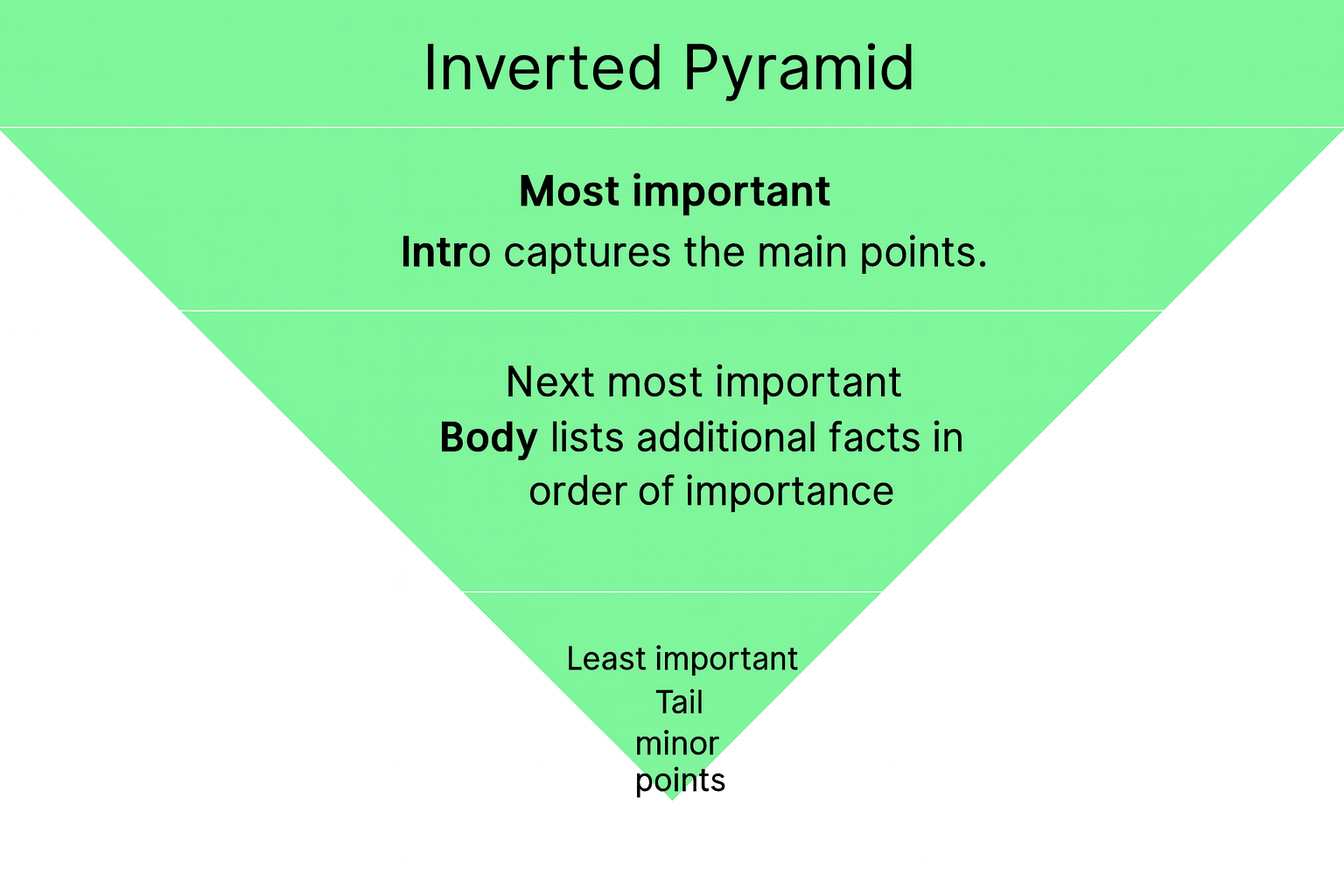
So you need to, like they taught me when I was studying to be a journalist, run an inverted pyramid model over your agenda. This means you group the most important things at the top – and that way, if time runs out and items are ignored, much like a newspaper editor with a shrinking newshole cuts my story in half, you’ve still covered the most important points.
I’ve seen meetings where the agenda and expectation steps can take most of the meeting. If that needs to happen, that’s perfectly fine because you’re better off doing that than discussing the wrong elements.
Steps 3-5: Discussion, Solution, Agreement (Repeat)
The bulk of most meetings run through these three steps:
- a discussion,
- a solution, and
- an agreement.
The context of this approach is “Momentum”, so here’s why we group those agenda items in the inverted pyramid, rather than listing them all. You don’t necessarily want to start the meeting with the most important item.
You want momentum, energy, progress. And to gain momentum I recommend you prioritise two or three simple things at the start of the triage process. They’re the first ones you want to discuss, solve, and get agreement on.
Crossing those items off the agenda, getting some agreements in the bag, gives you and the team momentum to keep the meeting going. Make sure you allow enough time for those most important – the big meeting items, the ones that are going to require a lot more discussion and maybe a bit more of a controversial solution.
As the Chair, your role is to guide the attendees (and their energy) through that cycle. Be clear about the specific Agenda item being discussed – the concept of “The Question Mark Agenda” suggests the Chair frame each item as a question that needs answering. Be clear on the purpose of this item – I talk elsewhere in this series about agenda items that should be emails, and so most items in good meetings will require some kind of Agreement about a Solution with the necessary Discussion beforehand.
It’s also okay that your Agreement in the meeting is an agreement to disagree; or an agreement for a smaller subsection of that group to go away and come up with a proposed solution for the next meeting. You don’t need to use everybody’s time to come up with solutions that maybe don’t require everybody’s input.
This process will cycle for as much time and agenda items as you have. Over time, as a meeting facilitator or chair, you’ll get better at moving the energy through that process faster making sure that everybody still feels heard that all the important points are raised but you don’t get horribly bogged down in the discussion or distracted by the million squirrels that can show up.
Step 6: Confirm Agreements and Actions
The last item in any meeting is taking the time to confirm the agreements that you’ve made and the actions that have been agreed. Therefore, having somebody document this is the most efficient process because at the very end, he or she can run through all of those. As noted above, I use Fireflies which can be calibrated to actually post its Action and Agreement notes in the comments of your Zoom (etc) meeting when your scheduled meeting reaches its final 10 minutes. Perfect!
Make sure you allow enough time at the end of the meeting to have that conversation because there’s no point making a whole heap of agreements that don’t get communicated and don’t get taken out into the wider business.
Stop Wasting Money via Meetings
It’s an interesting fact that in most corporations individuals have a very strict budget on how much money they spend; but they can seemingly call a meeting with thousands and thousands of dollars of hourly resource all just sitting around having a gasbag.
Make your meetings as efficient as possible and you will ensure that you get a return on investment for the time of each of those individuals sitting in a meeting.
Next Steps
Want to learn more about how this can apply to your business? It costs nothing to chat:
- Email me jacob@jacobaldridge.com (I read them all)
- Call, Text, or WhatsApp me +61 427 151 181
- Or just Subscribe https://jacobaldridge.com/about/subscribe-to-jacob-aldridge-com/ to stay in touch
[…] Funny, isn’t it? For all the #BlackboardFridays that have discussed strategies used to help businesses add millions in revenue, the episode with the best feedback was when we discussed how to run better meetings. […]
[…] we know that bad meetings can be terrible time wasters, but as we discussed in Blackboard Fridays episode 28 blaming ‘meetings’ for a lack of productivity is like blaming ‘spoons’ for […]