

The Sales Hourglass Part 1. In Blackboard Fridays Episode 10, Jacob talks about Sales and Customer Journey. Need this implemented into your business? Talk to the international business advisor who can do exactly that – Contact Jacob, Learn More, or Subscribe for Updates.
Who is Jacob Aldridge, Business Coach?
“The smart and quirky advisor who gets sh!t done in business.”
Since April 2006, I’ve been an international business advisor providing bespoke solutions for privately-owned businesses with 12-96 employees.
At this stage you have proven your business model, but you’re struggling to turn aspirations into day-to-day reality. You are still responsible for all 28 areas of your business, but you don’t have the time or budget to hire 28 different experts.
You need 1 person you can trust who can show you how everything in your business is connected, and which areas to prioritise first.
That’s me.
Learn more here. Or Let’s chat.
Transcript
Hi! I’m International Business Advisor Jacob Aldridge.
As you can imagine, when I go out and talk to business owners the topic of Sales is one that comes up repeatedly. I sat through my first Sales Training workshop (on VHS!) back in 1999 – so I’m talking from first hand experience when I say that concepts around ‘sales best practice’ have evolved an awful lot over time. Sales Training is always a popular topic.
Maybe you’ve heard of the “Sales Pipeline”, which I don’t think was ever accurate because a pipeline tends to be the same width with the beginning as it is at the end. Sales journeys do not look like that.
The “Sales Funnel” tried to abstract it a little bit more – and shout-out to Ray Leone from my Cigar Peg mastermind community, who actually invented the Sales Funnel concept before I was born! This is much more realistic – a lot of people come in at the top of the funnel, winnowing down on their way to the bottom.
But I think the concept of a sales funnel is dead because when you pour water into the funnel … it washes out at the end. You miss the opportunity to capture those relationships and build them for the long term.
Introducing the Sales Hourglass
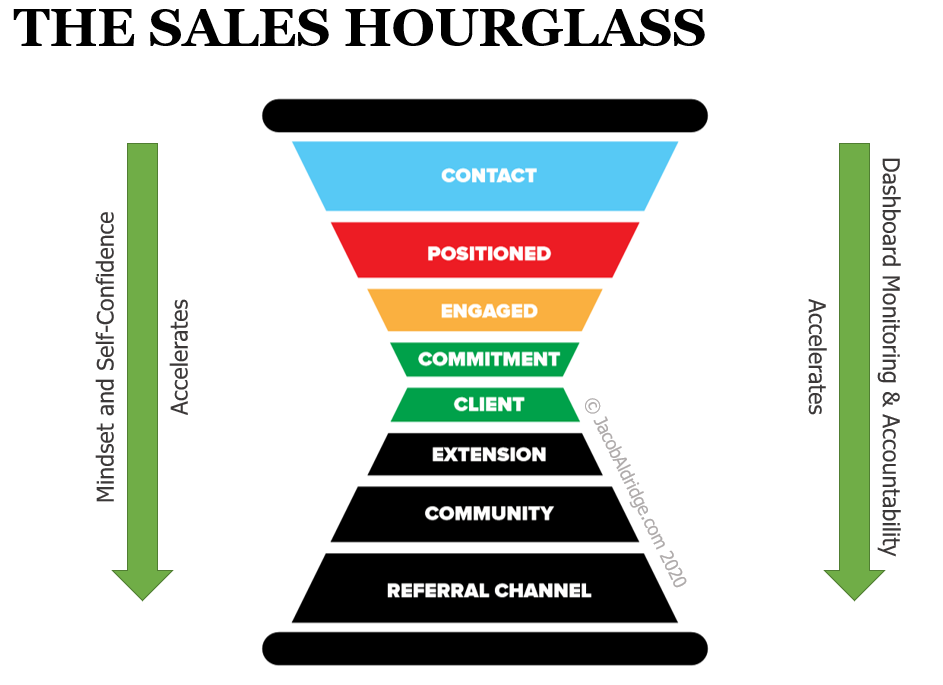
That’s why Como Business Coaching uses the concept of the “Sales Hourglass” — bringing people in, taking them through a journey where they become clients, and then also building on the relationship to the long-term. In regards to increasing your revenue, you can simply turn the hourglass … and have all those relationships run through again.
Let’s talk about the key categories that we use. In smaller businesses, you don’t need this many categories, but I find that they’re quite helpful to think about because many businesses overlook revenue generating opportunities just because they’re using a simplified model.
(1) Contacts
Right at the top of the funnel is a long list of most people that you may know. They’re your Contacts – they may be in a database, they may be receiving your email newsletter, they’re sitting somewhere in your system.
Contacts are people who are known to you, you’re known for them, but you don’t have much of a relationship. The biggest trap for small businesses and new salespeople is confusing Contacts for opportunities!
(2) Positioned with your Brand Promise
Only as we move through the Hourglass, does the relationship start to develop.
The first place those Contacts go, if they ever move down, is into a Positioned space. This means they now understand your brand, your brand promise, what you stand for, and what makes you special.
If these people were pushed, they’d be able to explain who you are and what you do. Again though, while they have increased awareness of your business, they’re still not looking to buy from you.
(3) Engaged
What you are really looking to do is to help move people that next step further. At this point they don’t just think about your brand in the abstract sense (“Jacob helps business owners”), they’re Engaged with why they, as an individual or a business, would use your business as a service (“Jacob helps business owners like me to achieve things like I want”).
The volume of opportunities you want flowing into your Hourglass depends on your business model and vision. There’s a universal truth, however – you want to oversubscribe the Contacts and Positioned steps, and either fully automate or at least leverage your time to move buyers through to Engaged. You do not want to be wasting your time pitching to people who aren’t yet Engaged – systemise those earlier steps.
(4) Commitment
Ever eaten a bacon and egg sarnie? The chicken is involved … but the pig is committed. If you think of your best clients, I’ll bet most of them went all in with you really quickly.
That leap can be difficult if you only have your Core Product to offer, especially if it’s a high ticket item. They might be falling in love with you, but if they’re not quite ready to buy that service you risk losing them if another suitor catches their eye.
Once they’re engaged, you are in a position to upsell them, to bring them as a client, or to develop that relationship. How then do you get them Committed? This is an opportunity to find a smaller, easier purchase they can make that cements your relationship.
Whether it’s ‘products for prospects’, a ‘loss leader’, or potentially even a free product or gift (that comes with some other commitment – like Alex Hormozi making people pay for shipping) this is a “Commitment Product”. Having a prospect commit a little bit of money to your relationship, particularly if your main client process is a large investment, helps win them over to your core product in time.
In an ideal world, your Commitment Product is also super profitable. If all it does is accelerate the journey from Engaged to Client, while reducing attrition and constipation, that’s a win.
(5) Client
There’s a long and fascinating etymology between clients (who lean on you) and customers (who make buying from you their habit), and it doesn’t really matter which you use. For the purpose of the Sales Hourglass, your Clients are those people or businesses who buy your core product.
Do you even know what your core product or service is? In a fragmented media world, having the right product ecosystem can be super valuable … and it starts by knowing which offering lives in the middle of your Hourglass.
Product Architecture is a related, but separate, exercise as part of the Como Business Coaching integrated management system. The numbers in this framework are the sequence with which that project progresses – and you can see how it fills in the Hourglass slices along the way.
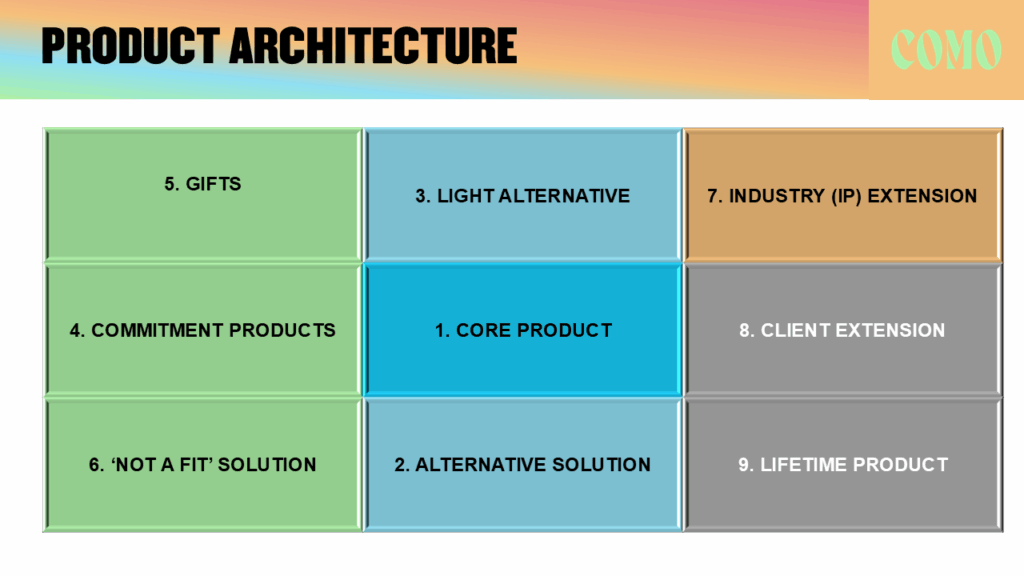
Now Client is where most businesses end the relationship – they do a great job, possibly for years and years and years, but that’s the end of it.
And if you’re great at what you do and don’t have a vision that requires tonnes of new clients, then this approach has many advantages – your ideal client makes it through to the bottom of the Funnel, and then lodges there for so long you don’t have to keep going back up to the top to find new prospects to funnel down.
Opportunity still remains for those businesses … and even more so if your business model is temporary, transactional, or not time intensive.
(6) Extension
What I love to work with businesses on is some of these ‘Bottoms of the Hourglass’ opportunities.
Where’s the Extension opportunity? If you’ve sold a client one product, where’s the extension opportunity to sell them a second, a third, or fourth? For small businesses, that may sound daunting or unnecessary, but don’t forget you can leverage partners in business, other businesses, or other business owners you have a relationship with in order to deliver that extension without you yourself having to develop everything.
There’s an adage: Your second product will always be more profitable than your first. This is a key reason why – the client is already working with you; they trust you; you understand them; and you don’t need to pay for them to go back through the journey. Why yes they do want fries with that, at a higher markup.
(7) Community
Most individuals these days are part of some sort of a Community, even if it’s as simple as social media groups. So what are you doing with your clients to get your business into their community?
Think this through – if they’re in a community of like-minded people, and they’ve decided that you are an awesome business to work with, chances are there are other people in that community that will also think you’re awesome to do business with.
When I complete a Strategic Business Review with a business, looking at their marketing spend can be the fastest way to drive profit and pay for myself. Too many SMEs are throwing money at Google AdWords and ‘Top of Funnel’ pursuits, when a fraction of that spend accessing Communities would deliver the faster and more profitable ‘Bottom of Hourglass’ clients.
(8) Strategic Referral Channels
The final slice of the Sales Hourglass takes the longest time to develop, and this is building referral channels. Did you know there are two types of referral channels:
- There are those who are Reactive Referrers. When somebody comes to them and says, “Hey do you know a fantastic-looking business advisor who does Blackboard videos on YouTube?” they’ll respond “Sure, you should go and talk to Jacob.” Reactive referrers are nice, but…
- What you are really looking for is Proactive Referral Channels. The sort of people who go out of their way to talk to your target clients and refer them to you. These strategic referrals are the type of people who go to a networking event, or down the pub on a Friday night, tap someone on the shoulder and say, “You’re in business, you need to talk to Jacob. Do what he tells you to do, pay what he tells you to pay, and thank me later.”
Most business owners are just focused on the reactive type of referrer. They go looking for width not depth, thinking ‘the more people out there, the more leads I’ll receive’. But having 100x as many fishing rods in the pond doesn’t help if the fish you want to catch are migrating in a nearby river.
There’s much more value in the proactive type – and it’s well worth an investment of your time.
[2025 Update: For Como Legal Coaching on YouTube, I recently published some training on How to Build Strategic Referral Channels for Family Lawyers – the examples are industry specific, but the core principles are universal.]
In Summary
You understand all the different levels that fit in your Sales Hourglass.
You can’t magically improve them all at once, so now you need to make a strategic decision about how you as a business will invest in developing which steps in which order.
Once you do so – as you will see in next week’s episode – you’ll find a much higher conversion rate of Contacts to Clients and then much more revenue generation opportunities to help your business grow revenue and profit.
Next Steps
Want to learn more about how this can apply to your business? It costs nothing to chat:
- Email me jacob@jacobaldridge.com (I read them all)
- Call, Text, or WhatsApp me +61 427 151 181
- Or just Subscribe https://jacobaldridge.com/about/subscribe-to-jacob-aldridge-com/ to stay in touch

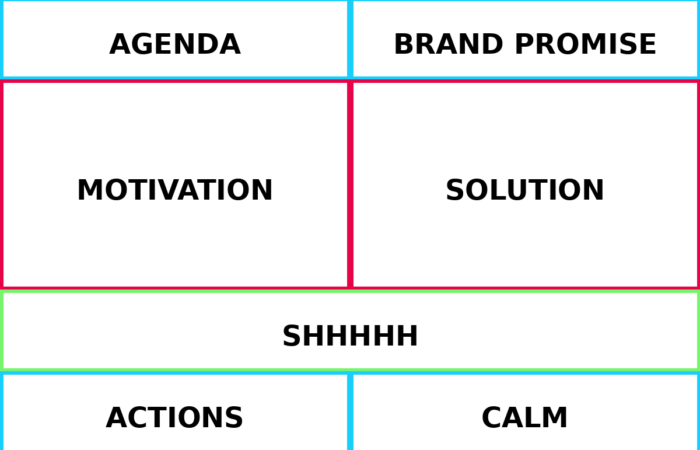

[…] remember back to the Sales Hourglass episode 10 and episode 11 of Blackboard Fridays, when we talked about the importance of Positioning and […]