The #1 Measurement in your business right now is one you’re probably not even tracking.
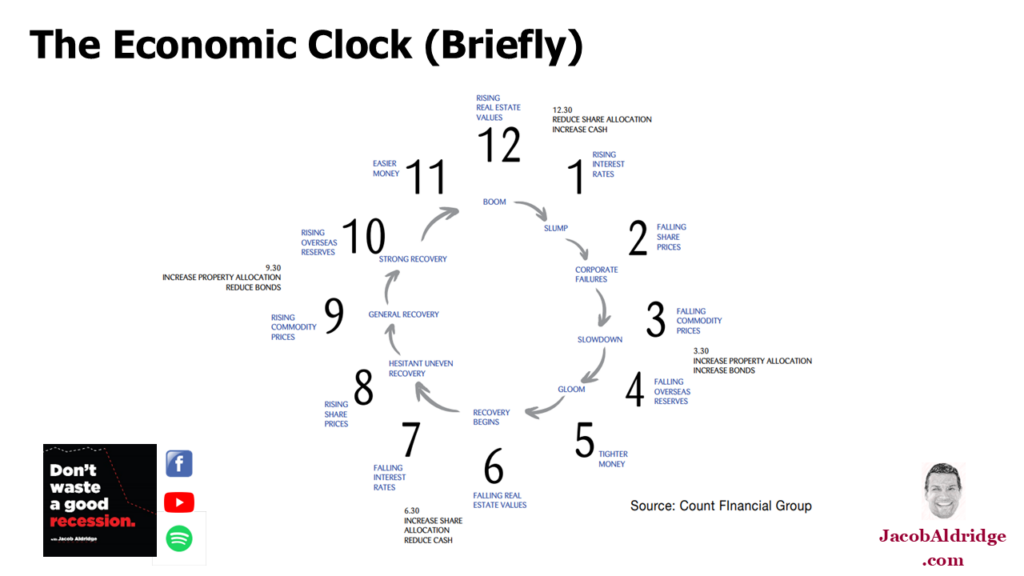
Here we are at the start of October 2026. The Economic Clock keeps ticking, and every month brings us closer to:
- The next downturn.
- The next recession. And
- (as I keep saying) The next great opportunity of your business life, because more opportunities are created in a recession than at any other time.
So how do you make sure you’re one of the businesses that thrives, rather than one that takes a punch to the face and goes down?
Right now, every client I work with (and in my own business) the conversation keeps coming back to cash. More specifically, the growing risk of cash absorption.
Revenue is vanity, profit is sanity… and cash is king
Many business owners judge their performance by looking at two things: your P&L … and your Bank Balance.
Your Profit & Loss statement is fine; in some ways it tells you how busy you were and where the money is likely to be next month. It will give you a sense of profitability – and profit is sanity.
But cash is king. You know this too, which is why you operate out of your bank account!
Cash Absorption bridges the gap between these two perspectives. If your P&L isn’t translating to your Bank Balance – this is where to look first.
Measuring “Free Cash Flow”
In my Strategic Financials workshop video I talk about Free Cash Flow and Net Cash Flow as critical numbers in your business. In the pre-recession financial reports I’m running with clients right now, we’re especially looking at the change in Free Cash Flow over time.
Most of us are familiar with comparing Revenue and Profit over time. What you want to see is simple: as Revenue goes up, Profit goes up too.
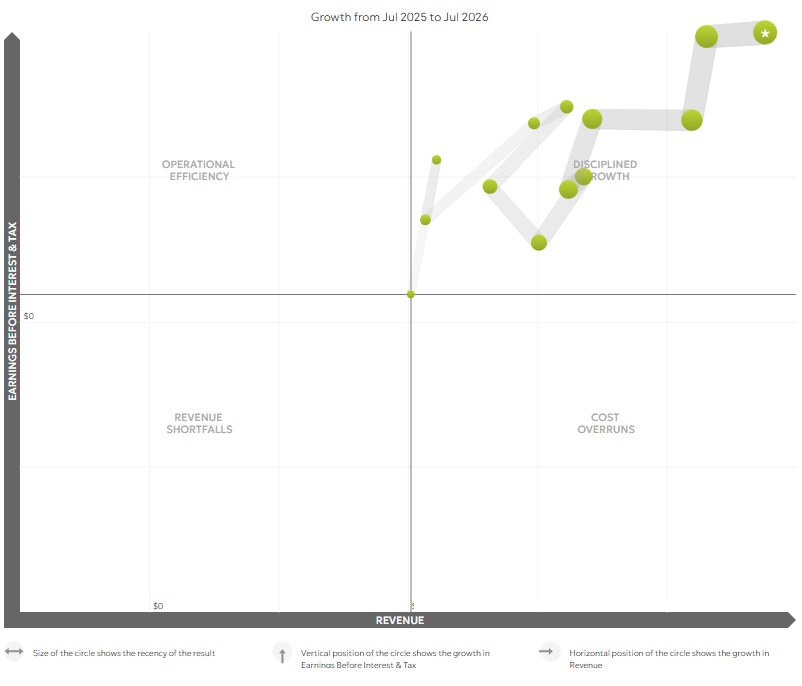
In the management reports I prepare I add an extra graphic: Revenue v Free Cash Flow.
Free Cash Flow goes well beyond profit. It tracks how cash actually moves through your business, including accounts receivable, accounts payable, other balance sheet items, taking on debt and paying it down. After all of that has moved, in and out at the end of each month, what’s left is your Free Cash Flow. This is the actual cash that has no other purpose, money you get to choose what to do with.
Some owners pay themselves from this bucket or top up their salary, and that’s a valid choice. Others treat it as a reserve they’re building, or capital to invest in future growth.
Right now, at this time on the Economic Clock, it has one more job: It’s the buffer you’ll need to execute the recession plan you’ve (hopefully) already started thinking about.
The Cash Absorption Quadrant
So now we’re comparing Revenue versus Free Cash Flow.
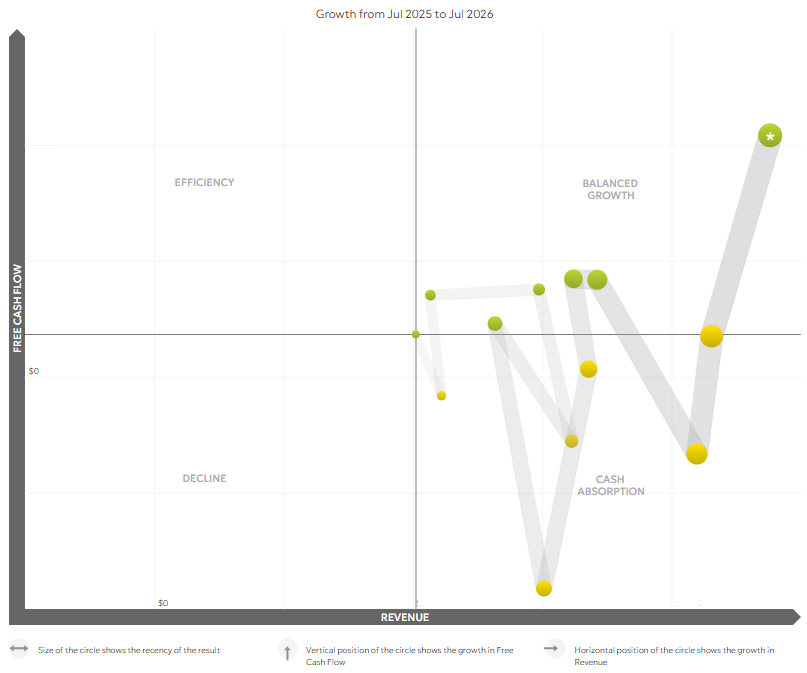
Profit doesn’t always rise neatly with Revenue. It tends to move in the steps of your Capacity Growth Plan, dipping in the months you invest ahead of growth (for example hiring a new team member or funding a marketing campaign – either will reduce your Profit this month, but hopefully grow Revenue and/or Profit in future months).
Cash works the same way, but over time you want Revenue and Free Cash Flow growing together. That’s disciplined growth. You’re not only growing the top line, or even only the bottom line. You end up with more money you can choose what to do with at the end of every month.
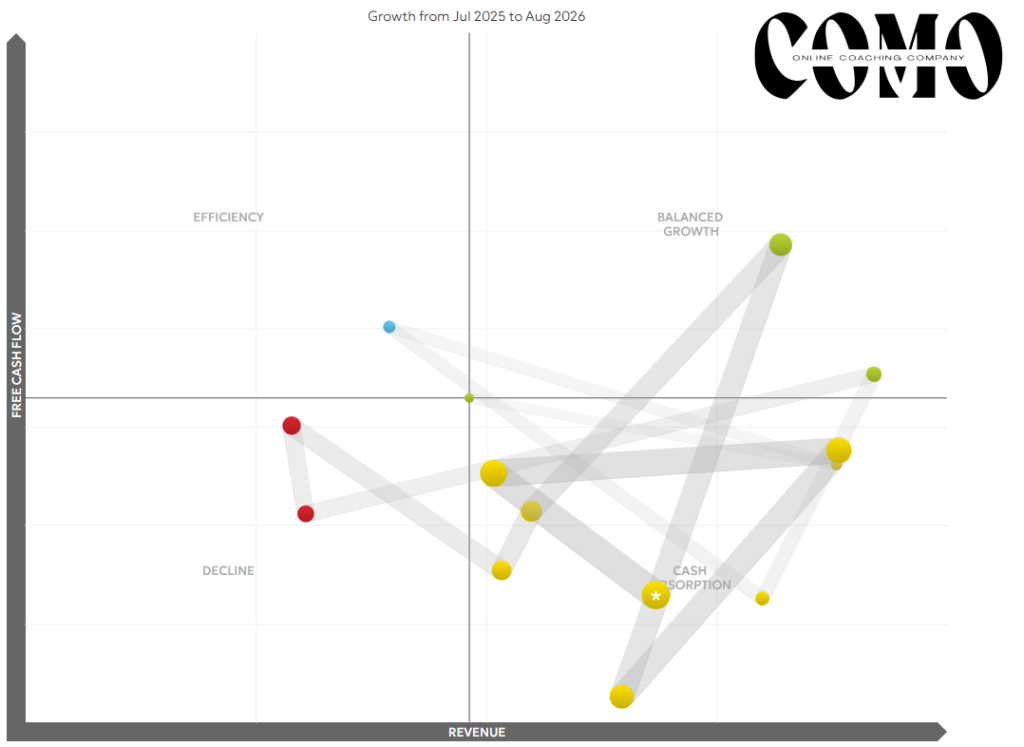
Right now, however, I’m seeing businesses slip into the Cash Absorption Quadrant. Revenue is growing, but monthly Free Cash Flow is falling, or at least falling against a benchmark like the same month last year.
In effect, you’re buying your revenue growth. Margins are being cut, expenses have crept up, and the cash that growth should produce gets absorbed before it ever reaches you.
I’m not the first to point out that the cost of living, and the cost of doing business, keep going up. Australia’s latest inflation figures jumped back up from 3.5% to 4.0% in August, the UK is creeping up, and the US had settled into the 2-3% band all the way through to…February.
Ahem.
…and has burst through. I expect things to get worse, much of the pressure flowing through from transport costs – and people taking my advice on pricing (see below).
This is worse than 2022
If this were 2022, coming out of the supply-side COVID recession, I’d be more relaxed about Cash Absorption. Pumping stimulus into a supply-side recession was always going to push prices up (as anyone who sat through my ‘Don’t Waste a Good Recession’ videos or podcasts in 2020/21 was warned about).
What we’re seeing now goes well beyond that because this time we’re not coming out of a recession, we’re heading into one.
That’s exactly when you need the most cash.
What to do about it
1. Raise your prices (and think higher)
Heading towards Christmas 2026, pricing is the most important lever you have.
Plenty of businesses are reluctant to raise prices because they know everyone is doing it tough. I understand that. But this may be your last, best chance the next two or three years to implement a strong price increase.
If you’ve been holding off, now is the time. And if you’re not sure how much to raise them by, think higher.
(If any of your suppliers are reading this… you’re not going to love that advice. But I digress.)
Your input costs are rising. Wage demands are rising. If you have a good team, you need to raise your prices while you still can, and every immediate dollar of a price increase goes straight to Free Cash Flow gifting you choice.
Will you lose clients? Almost certainly not. That fear stops so many of us, when in reality most clients value us well above what we charge them.
2. Get strategic about expenses
Are you managing your expenses deliberately, or just floating along?
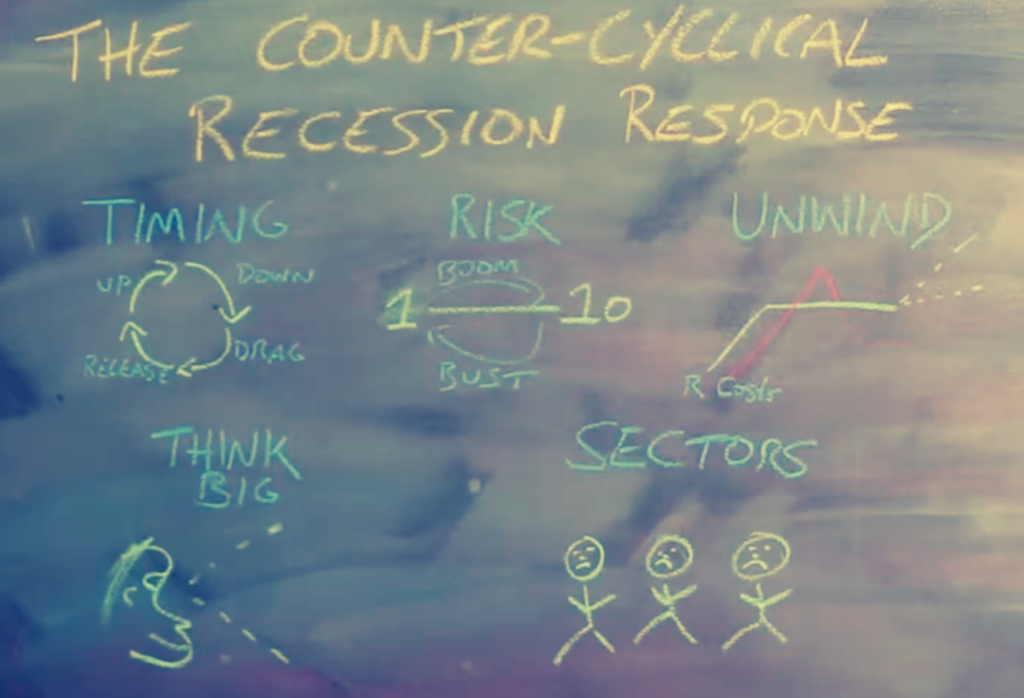
The trouble with a boom (11 or 12 o’clock on the Economic Clock) is that we stop worrying about the small things, and fat builds up in the business. In my pre-recession series on the Don’t Waste a Good Recession YouTube channel I talk about the Counter-Cyclical Response. Part of that is cutting much deeper than you expect to, so you create cash.
The more cash you bank now, the less you’ll have to worry about later.
The frog in the pot of boiling water
I’m writing this from Thailand, not a glass office in London, Singapore, Sydney or Dubai. We’re spending most of this year in South-East Asia as part of our full-time travel lifestyle.
Our purpose at Como Business Coaching is freedom through business, and for our family that freedom means travel. This region keeps us close to our Australian clients’ time zones and gives us a great Worldschooling community.
Yes, it’s much cheaper to live here, but the inflation complaints are still ubiquitous in Thailand, Vietnam, and Malaysia. When I’m back in Australia at the end of the year, I suspect the cost of everything is going to be quite the shock – let me know if you think I’ll be pleasantly surprised at how affordable things are?
If you’re in a high-cost country (Australia, the UK, the US, and frankly almost everywhere at the moment) you risk being the metaphorical frog in a slowly boiling pot. Prices have been climbing since 2022, and it’s easy to accept that as the new normal without asking what it’s doing to your business, your profit and, you guessed it, your cash flow.
Don’t let the water boil around you.
I’m not suggesting anything as drastic as moving your business offshore (although I am fielding more enquiries from Australian owners about their options ahead of the incoming tax changes, and I’m always happy to share my experience). Mostly this is about being smarter with your cash. The more attention you give it now, and the less you let revenue growth absorb it, the stronger your position will be when the opportunities arrive.
Who’s been swimming naked?
A rising tide lifts all boats. The pandemic left plenty of zombie businesses behind, kept alive by stimulus and the late stages of the economic cycle, that really have no business being in business. They’ve floated along just fine.
But as the saying goes, when the tide goes out you discover who’s been swimming naked.
That time is coming. Get your trousers on, and get cash in your pocket.
Need a hand? Maybe you’re stuck on how to measure your Free Cash Flow, or how to grow it month by month. Or maybe you’re sensibly looking at the next 12–18 months and asking how to plan, execute and profit through the next phase of the Economic Clock.
Either way, reach out any time. Helping business owners through this part of the cycle has been my great joy for the last 20 years.
And if you’re in Brisbane, Sydney, Melbourne, Hobart or Adelaide late this year, let me know in advance. I’d love to catch up while I’m passing through.

The sun may be setting. What are you wearing in the pool??