

How to Empower Your Team Part 1. In Blackboard Fridays Episode 21, Jacob talks about Leadership, Productivity, Culture, and Learning Development. Need this implemented into your business? Talk to the international business advisor who can do exactly that – Contact Jacob, Learn More, or Subscribe for Updates.
As an entrepreneurial business owner, you know that to grow your business you need to grow your team.
You will only be truly free to step up and achieve your business (and your life) vision when they are empowered to step up and take over. So how do you do that?
In Part 1 of this topic, I will walk through a simple framework that maps the employee journey – from hopeful new team members to empowered individuals.
I recommend Dan Pink’s RSA Animate talk Drive as an excellent overview of what really drives individuals – Autonomy, Mastery, and Purpose.
But how do you take that concept, and turn it to practical steps in your business? Doing so requires an understanding of the conflicting, competing desires that motivate or dishearten us as human beings.
Once you understand those 6 conflicting desires, you will be perfectly placed to watch Part 2 where we discuss the specific strategies you can execute to deliver these to every one of your team members.
Who is Jacob Aldridge, Business Coach?
“The smart and quirky advisor who gets sh!t done in business.”
Since April 2006, I’ve been an international business advisor providing bespoke solutions for privately-owned businesses with 12-96 employees.
At this stage you have proven your business model, but you’re struggling to turn aspirations into day-to-day reality. You are still responsible for all 28 areas of your business, but you don’t have the time or budget to hire 28 different experts.
You need 1 person you can trust who can show you how everything in your business is connected, and which areas to prioritise first.
That’s me.
Learn more here. Or Let’s chat.
Transcript
Every great business leader knows that you need to empower their employees.
For you as the entrepreneur, the CEO, to “Let Go To Grow” you need to let go into a team of engaged, empowered awesome individuals. How do you do that?
Introducing the Employee Empowerment Framework
This episode and next we’re going to go through a general framework and process for taking your employees on that journey, and then get into some specific steps. This will help you review your business, and see where you might be creating gaps that are getting in the way of creating those empowered, awesome employees that you want to come and work with.
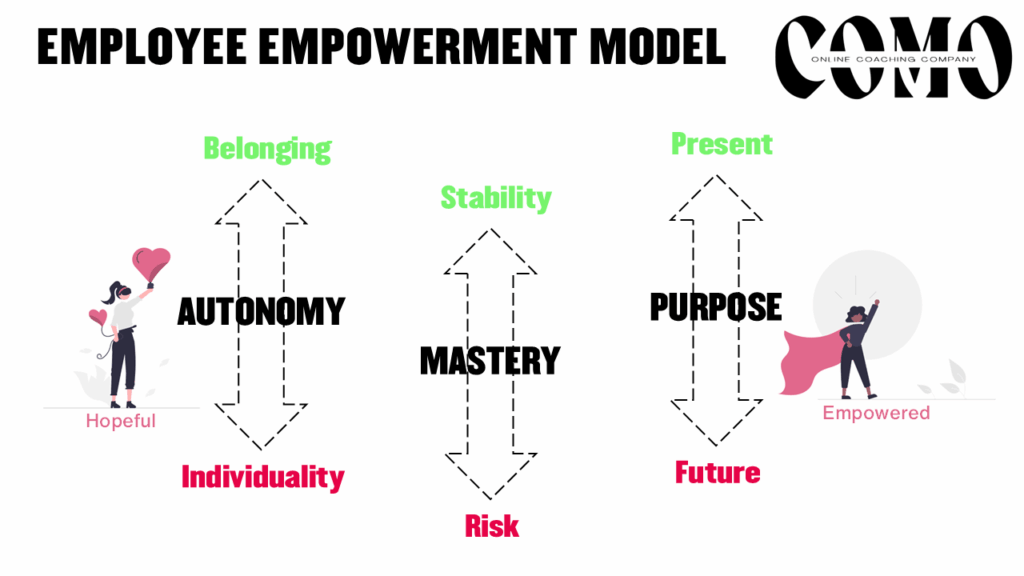
Let’s have a look at this as an overview this week. Starting on the left hand side of the Framework Diagram, you can see the Hopeful employee. This is someone who has recently started with your business, has just taken a job.
They’ve decided and made a commitment to come and work for your business; and you’ve made a decision and the commitment to bring them in. But both of you are in a space of hoping that this is going to work out, believing that it will, but knowing that it needs to be on the journey.
Where you want to take them to is this Empowered state at the other end of that journey, where they’re feeling both confident about the success of your business and empowered to make your business better because you’ve made them better.
Autonomy, Mastery, Purpose
Employment agreements – heck, most job ads – focus on money and time. However the key to engaging your employees is beyond that: You must focus on gifting them Autonomy, Mastery, and Purpose.
If you haven’t watched it, I would encourage to take the time to research and watch Dan Pink and his RSA Animate video Drive where he goes through the specific details and research that sits behind the importance of “Autonomy, Mastery, Purpose”, and the impact that has an engaging and empowering employee.
But view that research as a starting point only. In particular, I think Drive is too quick to rule out “Money” as a motivating factor. Above a certain level, roughly the median full-time income for an individual’s social circle, money starts becoming less important. But I’ve met too many coaches and business owners in the 15 years since Drive was published who dismiss payrises and bonuses as helpful for team engagement.
Put simply, if you don’t pay your team ‘enough’, then they will leave you for someone who will. Even if you have AMPed them up.
Motivation Beyond Money
I’ve also met plenty of business owners who believe that money is sufficient. We know this is not true, that people will generally make the decision to change jobs in a Feeling or Knowing space – and only then communicate it (to co-workers, friends, family) in a Thinking space. It’s easier to say “I’m making an extra $5,000/year” than to say “My manager didn’t trust me and I felt listless at work”.
So how do you implement Autonomy, Mastery, Purpose? How do you turn those broad concepts into tangible actions?
As you an see in this model, at Como we have broken each of the three elements down into the 6 Key Desires that we as humans as individuals have.
What that research tells us is that at each step of the process, we are all being pulled in two directions. This is the difficulty of people management.
We have these competing desires; therefore, it’s so frustrating sometimes working with team, working with clients, having children, being in relationship, because people are unpredictable, they want these mutually exclusive elements in their life.
The 6 Human Drives
(Keen fans will know I used this framework in the international best-selling management book Visionary Male Leaders.)
What are these 6 Human Drives, and why are they in conflict?
Things like “A Desire to Belong” and be part of something … while also seeking “Individuality”, wanting to be independent, alone, and unique.
We all want “Stability”, security in our lives … while also wanting to take “Risks” and try new things.
Similarly, we battle the need to be here in this “Present” moment to be focused and mindful, knowing what we’re doing right now is meaningful … while also craving the motivation to be creating something better for our “Future”.
Each of your team members is being pulled on those three axes and that’s having an impact on your ability to create the autonomy, mastery, purpose for them within your business.
When you’re giving your team members those needs, in a context of these key elements, you’ll be building a business that attracts the best people, empowers the best people, and makes you a business that people not only want to work, for they want to work with as clients and customers.
I’ll see you next week.
Next Steps
Want to learn more about how this can apply to your business? It costs nothing to chat:
- Email me jacob@jacobaldridge.com (I read them all)
- Call, Text, or WhatsApp me +61 427 151 181
- Or just Subscribe https://jacobaldridge.com/about/subscribe-to-jacob-aldridge-com/ to stay in touch



[…] loved episodes on “How to Empower Your Team to Step Up” – and you can watch Parts One and […]
[…] my favourite Blackboard Friday episodes are the two we created on Empowering Your Team (episodes 21 and […]
[…] Episode 21, How to Empower Your Team Part 1 – https://jacobaldridge.com/business/how-to-empower-your-team-part-1/ […]