

Ever Plan to Run a Business Strategy Day? This Agenda Will Help. In Blackboard Fridays Episode 33, Jacob talks about Growth Planning, Culture, and Productivity. Need this implemented into your business? Talk to the international business advisor who can do exactly that – Contact Jacob, Learn More, or Subscribe for Updates.
- Most small business owners struggle to find the time (meaning you aren’t truly clear about the value of time spent in this way), or
- You just don’t know how to do it.
Now, engaging an external facilitator or coach to run the day is one way to solve that problem. And that keeps me well stocked on conference room coffee and breathmints. But this is something you can do yourself.
All you need is a comprehensive guide to running a good strategy day (preferably for your General Manager, Office Manager, or 2IC to read and implement) – like this one titled, conveniently, “How to Run a Great Business Strategy Day“.
And a clear agenda for creating a day that delivers practical business results. Conveniently, explaining that agenda is the focus of this week’s episode.
Who is Jacob Aldridge, Business Coach?
“The smart and quirky advisor who gets sh!t done in business.”
Since April 2006, I’ve been an international business advisor providing bespoke solutions for privately-owned businesses with 12-96 employees.
At this stage you have proven your business model, but you’re struggling to turn aspirations into day-to-day reality. You are still responsible for all 28 areas of your business, but you don’t have the time or budget to hire 28 different experts.
You need 1 person you can trust who can show you how everything in your business is connected, and which areas to prioritise first.
That’s me.
Learn more here. Or Let’s chat.
Transcript
Welcome and Happy New Year.
Let me start with an aside: In 2012, I spent a lot of time traveling the world with my beautiful wife (the inspiration for our current full-time travel lifestyle) and I set myself the quirky challenge of wishing people a Happy New Year for as late into the year as I possibly could.
One of the benefits of traveling all the way around the world meant I got away with it all the way through to December – I managed to wish people a Happy New Year in every single month of the year and not even one of them blinked.
So, if you’re looking for an excuse to focus your business, to think strategically, and to set that next growth plan, don’t feel that it needs to be the start of a calendar or financial year to do it. Just do it.
This process can help you at any time of the year, but as we know sometimes a new year can be the inspiration that a business owner or their team needs to reset the strategy.
Navigating The Year
What we’re walking through today is a very simple agenda that I use called “Navigating the Year”. This is the process that I take clients through, some of my clients now run it themselves, to set out where this year is going to target in terms of their vision, their strategy, and their resources.
So, let’s walk through it.
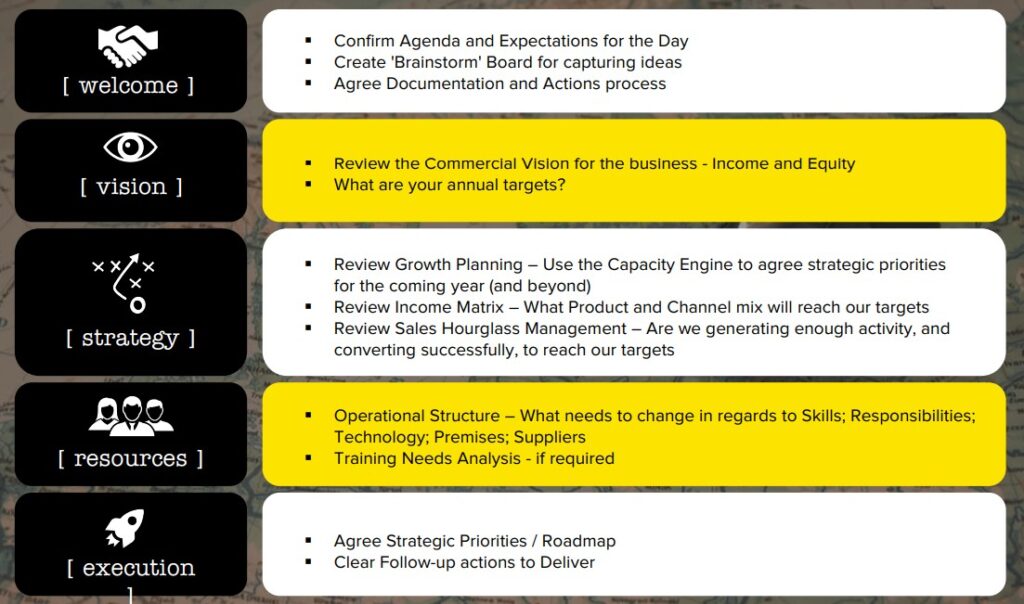
The first thing you’ll notice is that I call this an annual strategy day. That’s the most common way business owners do this, they put aside a day get the leadership team (or in a business of say 12 or fewer staff, they get the whole business together) – they may go off-site to get out of the stuff that can go on within a business, they put aside a day to do strategy.
Now for some businesses a half-day is appropriate. For others, we do a two-day retreat so we can dive a lot deeper into the detail around some of these elements. The length of time does depend a little bit on your business and how much you want to invest in growth of your business.
Welcome
(i) Welcome. 5-10% of your day
- Confirm the Agenda and Expectations for the Day
- Create a ‘Brainstorm’ Board for capturing ideas
- Agree Documentation and Actions process
Once the team are ready, start with a welcome process that involves not checking in on how everyone is feeling. This is critical, because if you’ve got someone who got stuck in traffic, was running late, hasn’t had the coffee that they need, you’d rather that they shared that at the beginning of the day than act out because of it through all these other conversations. So do a check-in about how people are feeling.
Then give them the chance to add whatever they want to the agenda for the day. Now, you have a set Agenda which you shared with the team beforehand, but if there are concerns going on for your team you want to get those out. Don’t lose the opportunity for meaningful strategic progress just because some of your team are waiting the whole day for a chance to talk about the new photocopier or their frustration about the lack of cleanliness in the kitchen.
Get those things out. Maybe you won’t be able to cover them all during the day, but if you follow this process, you’ll find a lot of the times that you do.
Vision
(ii) Vision. 10-30% of your day
- Review the Commercial Vision for our business – Income and Equity
- If you don’t have a documented Vision, give yourself more time here to create it using the strategic frameworks in my vision videos above
- What are our Annual and Quarterly Targets?
Next, we move into the three core conversations: Vision, Strategy, Resources. If you’re a big Blackboard Fridays fan, you remember one of the first videos that we shot was around The 5 Whys, the different layers of context that give meaning to the decisions you make day-to-day. Vision, Strategy, and Resources are the highest three levels of Context within a business – your Vision guides your Strategy, which then guides your Resource decisions.
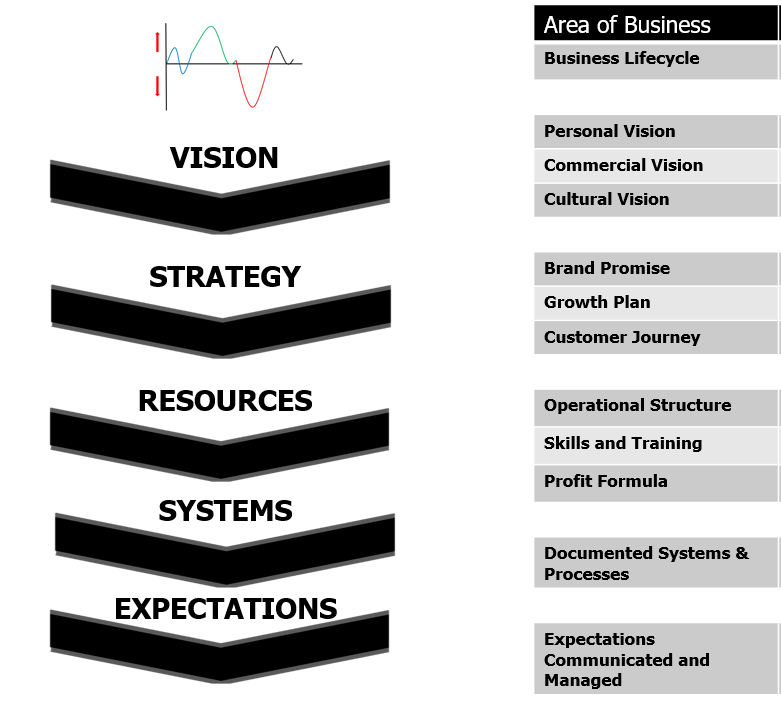
What if you don’t already have a clear Vision?
If you haven’t set out and documented your Vision (and thus by extension your strategy and resource plan), this is your chance to create the first draft with your leadership team.
Maybe you’ll come back to it in a month, or six months, or next year and refine it – but now’s the chance to have the conversation and get that first step done.
And if you do have a clear Vision, this step in your Annual Strategy Day is the time to review.
That’s why I call this an annual strategy day. Something that you do on a regular basis – at least annually. A Vision check-in and review is not something that you do every three years or five years when something hits the fan – get into the consistent process of making it happen.
So, reviewing your vision, you’re reviewing:
- Your Commercial Vision, the long-term growth that you want to achieve for the business, and
- Your Cultural Vision, which could even mean putting things like your and purpose and values on the table to be discussed and reviewed.
Oftentimes I find clients and their leadership teams use this process to affirm and tick off the Commercial and Cultural Vision – and then focus the conversation on what’s the vision for this 12-month period. What is it specifically that we’re going to achieve commercially and culturally if change needs to occur in the coming year? That then guides your strategy.
Strategy
(iii) Strategy. 20-30% of your day
- Review Growth Planning – use the Capacity Engine to agree Strategic Priorities for the coming year (and beyond)
- Review Income Matrix – What Product and Channel mix will reach our targets?
- Review Sales Hourglass Management – Are we generating enough activity, and converting successfully, to reach our targets?
So reviewing the Strategic Roadmap that you have, where are we on that journey from now to that vision point, do we feel that the strategic steps that we’re currently focused on and that we’ve got coming up in that ordered set of priorities are the best ones to get us to that vision?
These things can change, market forces change, new opportunities show up, your passion or your team’s passion may change. Review the strategy, don’t have it set in stone, but have it documented so that you can pull it out, analyse, and discuss.
Two other strategic elements that I recommended are your Income Matrix and Sales Hourglass.
Your Income Matrix is a simple exercise that maps the different products and services you sell, and the different clients or markets that you sell it into. If you’ve got a budget to the year, what’s the breakdown of that across the different services and the different markets?
In a smaller business, that could be as simple as the different individuals and some of the different key clients that you’ve got. That gives a specific focus to the revenue strategy.
To your Sales Hourglass, and again if that’s not something you’re familiar with, go back to some of the earlier Blackboard Fridays videos where we dive into that in a little bit of detail.
Get clear on your sales process, the journey that your customers and future customers are going through. Where are they getting bottlenecks? Where are they getting stuck? Have you got the inflow of work that you need? And are you at the other end of the hourglass being able to leverage that into more revenue and equity opportunities?
Resources
(iv) Resources. 20-30% of your day
- Operational Structure – What needs to change in regards to Skills, Responsibilities, Technology, Premises, Suppliers etc?
- Training Needs Analysis – if required
Lastly, an examination of your Resources, and this is twofold.
One is your Resource Mix. You may find that even though you have all the right people in the business, they’re not necessarily playing in the right position. The skills have changed, maybe times have changed, maybe somebody’s got some spare capacity, or they’re overwhelmed and at capacity stress.
Now is an opportunity to reduce some of those roles and responsibilities so that you’ve got the right people doing the right tasks at the right time. That leads naturally into a conversation about skills. Maybe even conducting the Training Needs Analysis like we discussed in the last episode to identify where there are still gaps or perceived skill gaps in your team that over the coming 12 months, you can put forward a training plan to help them and your business navigate through developing those skills.
Execution
(v) Execution. 5-10% of your day
- Agree Strategic Priorities and Roadmap
- Confirm the clear decisions and actions agreed to ensure you execute on your strategic plan
Lastly – and this is critical and something that runs through the whole process – Execution. Being clear about the Agreements and the Actions that have been made during the day.
I run a lot of strategy days with white boards and blackboards, where from the start we’ve got a section for actions and agreements that get documented throughout the day . This means that when we get to the end of the day, they’re already sitting there, it’s not a monumental task for any one individual.
At the end of the day ideas – and you will come up with some fantastic ideas – are completely worthless. It’s only when you execute them that you get value out of them.
Execution is priceless so make sure that you don’t leave your Strategy Day / half day /two-day off-site retreat without being very clear about what has been agreed and who is going away to turn those agreements into reality.
Next Steps
Want to learn more about how this can apply to your business? It costs nothing to chat:
- Email me jacob@jacobaldridge.com (I read them all)
- Call, Text, or WhatsApp me +61 427 151 181
- Or just Subscribe https://jacobaldridge.com/about/subscribe-to-jacob-aldridge-com/ to stay in touch



[…] Episode 33, How to Run an Annual Strategy Day – https://jacobaldridge.com/business/ever-plan-to-run-a-business-strategy-day-this-agenda-will-help/&n… […]